Breath sounds like wellness-influencer territory until you understand the wiring. The way you breathe directly determines which branch of your nervous system is in charge — and which branch is in charge determines what kind of sex you're capable of having. The breathwork practices that improve sex aren't mystical. They're mechanical.
The wiring, briefly
The autonomic nervous system has two main branches. The sympathetic branch handles fight-or-flight; the parasympathetic branch handles rest-and-connect. Your breathing pattern is one of the few autonomic functions you can consciously control — and changing your breathing changes which branch is dominant.
Specifically:
- Fast, shallow, chest-led breathing activates sympathetic. The body interprets it as alarm.
- Slow, deep, belly-led breathing activates parasympathetic. Especially long exhales.
Sex requires parasympathetic dominance. Erections, lubrication, the smooth-muscle relaxation that opens blood flow to the genitals — all parasympathetic events. Anxious or shallow breathing during sex actively works against the body's ability to respond.
This is why the simple instruction "breathe" — given by sex therapists, somatic practitioners, even good lovers — isn't just calming language. It's nervous system intervention.
Practice 1: The slow-exhale primer
The simplest and most reliable. Use it before sex, during the slow buildup, or whenever you notice you're getting into your head.
The pattern:
- Inhale through the nose for 4 counts
- Exhale through the nose or slightly parted lips for 6-8 counts
- The exhale longer than the inhale is the key — it's specifically the long exhale that activates the vagus nerve and triggers parasympathetic dominance
- Repeat for 2-3 minutes
You should feel a measurable settling. Heart rate slows. Shoulders drop slightly. Attention moves from racing thoughts to the body.
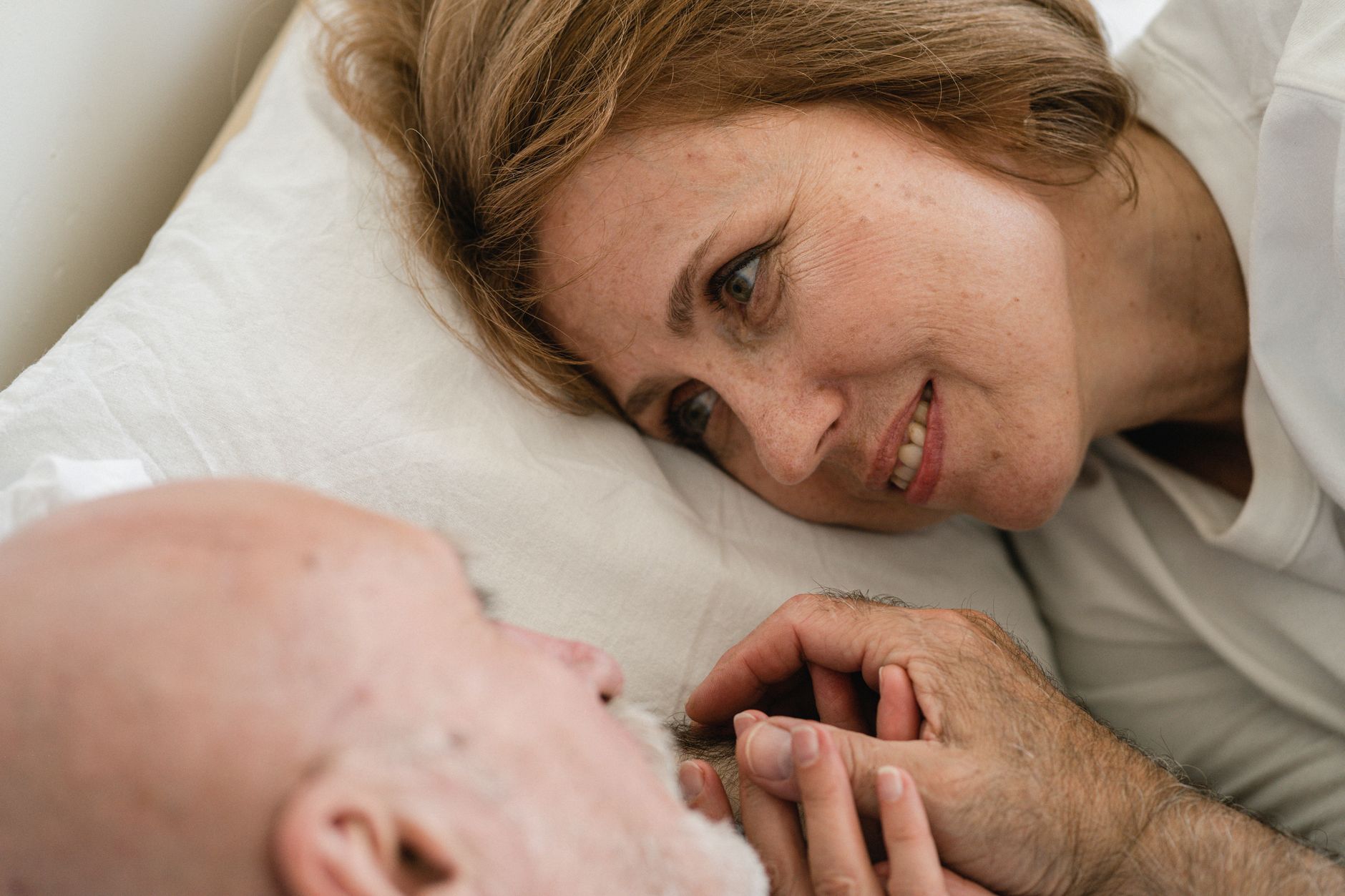
This is unromantic if you treat it as a practice; it's beautifully integrated if you do it with your partner during the slow start of an encounter. Lying together, both breathing slowly. The synchronisation alone produces a kind of attunement.
Practice 2: Synchronised breathing with a partner
Couples who breathe together during sex — even briefly — report measurable differences in connection and arousal. The mechanism is simple: synchronised breathing creates physiological coupling. Heart rates and nervous systems start to align.
How to do it:
- Face each other, sitting or lying down, close.
- One partner sets the pace — slow inhale, slower exhale.
- The other matches.
- Stay there for 2-3 minutes before any other contact, or weave it into pauses during sex.
The first time you do it feels strange. The third time, the effect becomes obvious. By the time it's a regular practice, you'll notice the difference between sex with breath synchronisation and sex without.
Practice 3: Breathing with rising arousal
This one's slightly more advanced. The principle: as arousal rises, the natural inclination is to start breathing faster. Faster breath escalates intensity but also tips into sympathetic — which can either accelerate orgasm too quickly or block it entirely depending on the body.
Conscious breath modulation as arousal rises:
- Notice when your breath quickens involuntarily
- If you want the arousal to climb without tipping over, slow the breath deliberately — keep exhales long
- If you want to accelerate toward orgasm, allow the breath to quicken naturally
- If orgasm has been elusive, slowing the breath at the moment of "almost there" sometimes lets the body cross a threshold the rushing was preventing
This is particularly useful for people who consistently come close to orgasm and lose it — the breath holding or tensing at the critical moment is often the saboteur. Replacing it with steady deep breath sometimes makes the orgasm available.
Breathing into specific body parts
A somatic technique with surprising effects. Direct your inhale toward a specific body part — your pelvis, your chest, your hips. Imagine the breath going there. The act of attention plus breath frequently increases sensation in that area.
Especially useful for:
- Areas that feel numb or disconnected during sex
- The pelvic floor — many adults hold chronic tension there; breathing into the pelvis specifically helps it release
- Areas that have been unresponsive — the breath-and-attention practice often "wakes them up"
The "fire breath" warning
Some breathwork traditions include rapid, forceful breathing techniques (kapalbhati, breath of fire, holotropic breathing). These have their place but are not the right tool for sex. They activate sympathetic, induce light-headedness, and disrupt the parasympathetic state arousal requires.
The breath that helps sex is slow and deep, not fast and forceful.
Breath holding
People who tense or hold their breath at the edge of orgasm often find this is preventing them from crossing into climax. The body tightens, the breath stops, and the orgasm doesn't quite arrive.
The intervention: deliberately keep breathing through the threshold. Even forced exhales. The breath becomes a vehicle for the orgasm rather than something that pauses for it.
For some people, this single change unlocks orgasms that have been stuck for years.
Audible breath
Letting your breath be heard during sex is its own thing. Sounds like a stylistic preference; it's actually mechanical. Audible exhales communicate to your partner what's happening for you, and to your own body what state you're in. Silent sex tends to be tighter, more held; sex with audible breath tends to be more present.
If audible breath feels exposed or weird, start small. Just slightly louder than usual. The vulnerability of being heard breathing is part of what creates the deeper presence.
Solo breathwork practices
Worth doing outside of sex too:
- Five minutes a day of slow breathing — builds the baseline tone
- "Box breathing" (4 in, 4 hold, 4 out, 4 hold) for general nervous system regulation
- Diaphragmatic (belly) breathing as a default — most adults breathe shallowly into the chest by habit; retraining the breath to the belly takes a few weeks
The baseline you build outside of sex is the baseline that becomes available during it.
What changes after a few weeks
Couples who introduce conscious breathwork into their regular sexual practice usually report:
- Easier arrival in arousal — less time to "get there"
- Stronger physical response — fuller erections, more lubrication, more sensation
- Better presence — less mind-wandering during sex
- More intense orgasms when they occur
- Greater connection during the encounter as a whole
It sounds too simple to be true. It's also one of the practices with the strongest physiological basis in this whole area.
The bottom line
Breath is the lever you can pull in real time to change which nervous system is in charge of your sex. Slow exhales, synchronised breathing with a partner, conscious modulation as arousal rises, audible breath rather than silent — these are simple, repeatable, and work.
If your sex feels tight, performance-driven, or hard to fully arrive in, the cheapest intervention available is to breathe slower and deeper. The body reorganises itself around what the breath is doing. Try it for a month and see what shifts.